What You Need to Know About Other Transaction Agreements
Oct 19, 2026
Reading time: 10 minutes
Even though they are far from new, non-traditional acquisition methods are all the rage right now. It’s no coincidence that LinkedIn feeds are full of Other Transaction (OT) Agreements and Commercial Solutions Openings (CSOs). On April 16, 2025, President Trump signed an executive order called “Ensuring Commercial, Cost-Effective Solutions in Federal Contracting.” EO 14271 “directs the administration to prioritize the procurement of commercially available products and services.” The Government also released the Guide to Prototype Other Transactions on the 14th of October. As the federal government moves to procure commercially available products, government contracting is pivoting. Understanding the differences among the alphabet soup can feel like a full-time job.
In this blog, we’ll explain OT Agreements and cover the categories below:
- OT Authority vs OT Agreements
- 5 Things to Know Before Pursuing an OT Agreement
- Non-Traditional Defense Contractors (NTDCs)
- Consortia
- OT Bid Protests
- OT Pricing Notes
OT Authority versus OT Agreements
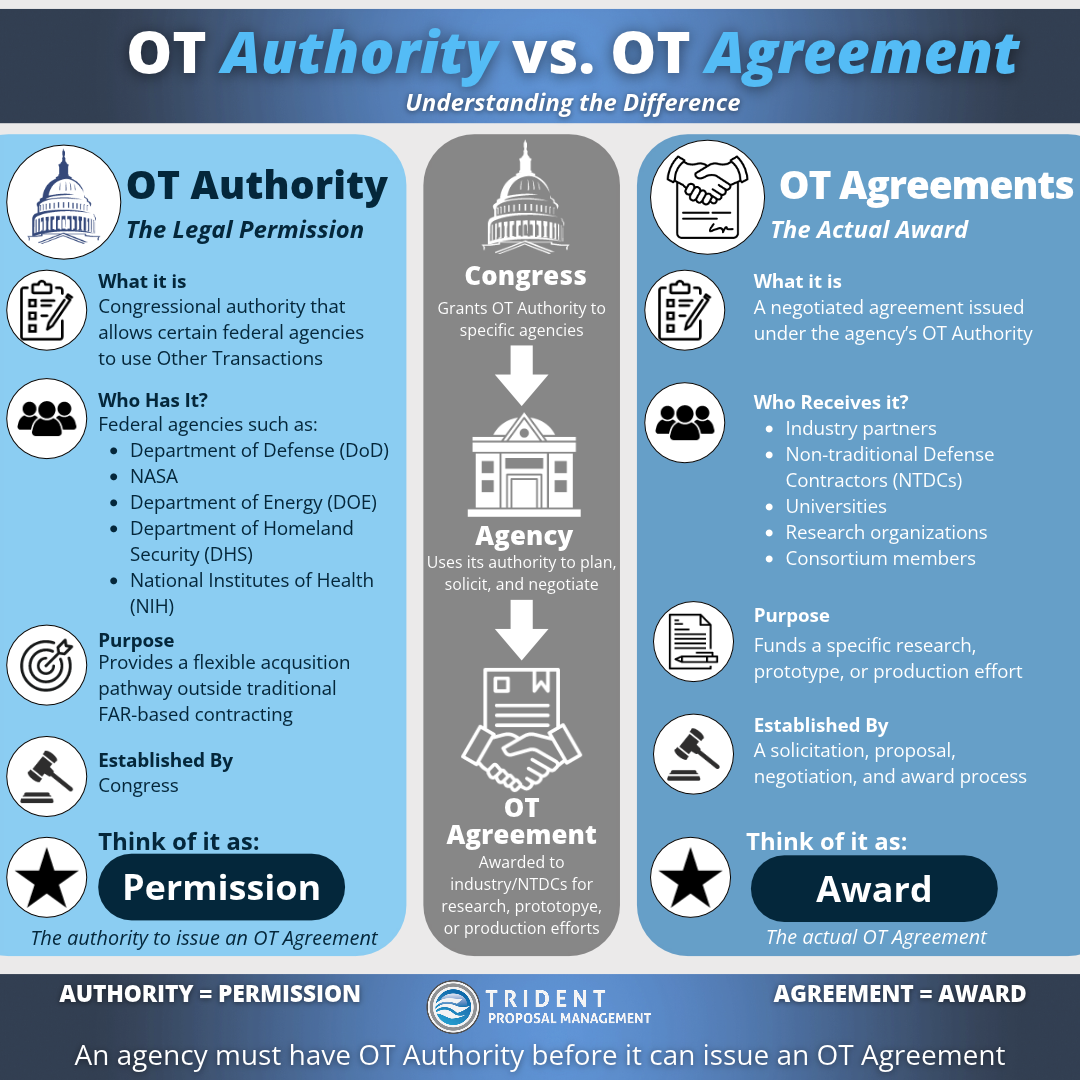
The term “OTA” is tossed around a lot in government contracting. What’s unique is that OTA is often used interchangeably to mean Other Transaction Agreement and Other Transaction Authority. These two OTAs, however, are not the same.
An OT Authority is a congressionally-approved organization authorized to use flexible contracting, such as OT agreements (source). A 2016 Government Accountability Office report found that only 11 agencies have congressional approval for OT authority. OT agreements, on the other hand, are the non-FAR based contracts issued under OT authorities. When you work with an organization that has OT Authority, you’ll negotiate contracts with an Agreements Officer rather than a Contracting Officer.
The simplest way to understand this is that Other Transaction Authority is the authority, and Other Transaction Agreements are the legally binding agreements from OT Authorities. Put another way, the OT authority is like the DMV. This is the government’s ability to issue you a license. The OT agreement is the license that let’s you actually drive. When you begin pursuing OT agreements, and you win (Trident can help!), it’s more accurate to say, “We won an OT agreement awarded under Agency X’s other transaction authority.”
OT Agreements
OT agreements are contractual agreements not governed by the FAR, which can be both beneficial and risky for your company. In a lot of ways, the complexity of the FAR is a result of guidelines and standards that have been put in place to act as protections for your business. When we step away from those protections, we gain flexibility, which means we can operate more quickly (in some cases) and creatively to form innovative business arrangements with the government, which is why we’re interested in Other Transaction Agreements.
There are three* primary types of OT agreements:
- Research: Supports basic, applied, and advanced research, encouraging dual-use research and development while minimizing government regulatory burdens on companies. OUSD(R&E) provides policy and guidance on Research OTs.
- Prototype: Acquires prototype capabilities for both dual-use and defense-specific projects. Successful prototypes can transition into production without additional competition, simplifying the path to follow-on production.
- Production: Following successful prototypes, OT agreements allow the government to move directly into production without further competition, streamlining the transition to full-scale production.
- *Construction: This one is brand new and only applicable (so far) to the Department of War thanks to a pilot program outlined in the 2026 National Defense Authorization Act. These support prototype projects that “evaluate new construction techniques and technologies for military installations and facilities.”
OT agreements are ultimately governed by the United States Code (USC) for maximum flexibility:
- USC = federal laws created by Congress
- FAR = federal regulations created by federal agencies
Now that we have the basic language of OT Agreements, let’s talk a bit about how they work in the real world. There are five key things you should remember when you explore this non-traditional acquisition option.
5 Things to Know Before Pursuing an OT Agreement
Consideration 1: Understand the Phases and Process
OT Agreements can originate in a variety of ways: “Agencies that intend to award only OTs from a solicitation are free to create their own process to solicit and assess potential solutions” (Source). This means that OT Agreements can be awarded through Requests for Prototypes (RPPs), White Papers, Broad Agency Announcements (BAAs), consortia, or even Commercial Solutions (Openings), often referred to as CSOs. An OT Authority does NOT need to use one of the more traditional means to advertise their capability need.
What does this mean for you as an industry member looking to provide an innovative solution to the government? It means it is more critical than ever to build and maintain relationships with your current and desired clients’ requirements managers. Each department or agency can advertise, conduct research, and negotiate OT Agreements outside traditional SAM.gov advertising routes. They may have their own websites, marketplaces, or portals where they post their OT Agreement-related information.
In a non-FAR-based competition, the government can begin contract negotiations with the industry partner at any point in the process. This is often specified in CSOs but is true of OT Agreements as well. When this happens, the Agreements Officer (AO) – not the same as a Contracting Officer; the AO has additional training on how to execute an OT – meets with the industry partner to build the agreement you’ll use to bring the solution to life. Rather than issuing a solicitation with guidelines that then become the contract, you and the AO develop an agreement to guide your work.
Because OTAs are reserved for specific process development work, many AOs use a phased approach to help them screen potential industry partners. Under a CSO, an OT Agreement may have three phases: submitting a white paper, providing an oral presentation or technical demonstration, or submitting a full technical proposal before moving into contractual negotiations. If it is a stand-alone OT Agreement announcement not released under a CSO, the AO may be ready to negotiate after an initial review of the capability pitch. Each OT Agreement may be competed differently, so understanding the intentions of the office you are working with is critical.
Consideration 2: Gather All Governing Documents
A key difference between FAR-based solicitations and OT announcements is that the government is not mandated to publish these opportunities. “OTs are exempt from multiple procurement-related statutory and regulatory requirements, such as those involving solicitation, publication, competition, and pricing,” according to Congress.
Unlike OT Agreements, the government must post CSO announcements to broad audiences, so CSOs are posted on at least SAM.gov. However, from there, tracking topics and capability gaps gets murky and fragmented across federal agencies. Offices can keep their categories on their own websites (e.g. SOFWERX) or use marketplaces (like Tradewinds) to post and update specific needs announcements after the initial CSO. So, if you’re responding to an OT Agreement, make sure you have all the governing instructions you need to understand the process the government intends to follow as it navigates your agreement.
Trident Tip: Marketplaces like Tradewinds don’t necessarily result in passive awarded work. They still require marketing and relationship development with your clients, so this is not a place where you can post your pitch and wait for money to come to you.
Should the OT Agreement announcement be placed underneath a more formal solicitation method, like a CSO or a BAA, the response to that announcement must be compliant with all aspects, even if they are posted in two different locations. An Army office may post its OT announcement on its own website and note that its OT falls under the AOS CSO. If so, industry would need to comply with both the AOS and the OT requirements https://www.congress.gov/crs-product/IF12856.
Consideration 3: Define Success Criteria Early
When you move into contract negotiations, one of the things you need to establish with the AO is the success criteria for your agreement. These criteria govern whether your OT Agreement is complete and whether you have provided the contracted solution. Before beginning these negotiations, take the time to develop realistic success criteria that fit within your solution and provide clear, concise ways to conclude your work.
Consideration 4: Plan for Follow-On Production
Prototype OT agreements allow for follow-on production provisions in the initial agreement. This may describe a single prototype development. It may also describe iterative prototype development or another way to carry the solution forward. Understanding the differences between how production may occur is important as you work through your negotiation process. Your team should also understand the logistical, scheduling, cost, and personnel requirements associated with your follow-on production agreements.
We want to stress the importance of thoughtfully considering both success criteria and follow-on production because each interaction you have with the government can affect your past performance ratings and evaluations. Your company’s reputation is important—even in non-traditional contracting—and the thoughtful evaluation of these two aspects of your agreement may greatly affect your ability to deliver quality within the constraints of the schedule and agreement that you develop. Additionally, all CSOs and many OTAs are firm fixed price or include a milestone-based payment schedule, which may leave your company with more risk. Take the time to think through these considerations before you submit your proposal.
Consideration 5: Protect Data Rights and Intellectual Property Protections
One way the FAR safeguards your business is by defending Data Rights and Intellectual Property. This does not exist when you are establishing an OT Agreement, so you must negotiate it during the contract period with your AO.
If you begin negotiations without being fully informed about your data rights and intellectual property protection expectations, you run the risk of passing along your unique solution to someone else.
Taking the time with your legal team to ensure you protect your solution as you work with the Government, and including these protections in your OT Agreements is critically important.
Non-Traditional Defense Contractors
An NTDC is any entity that has not performed a DoD cost accounting standards-covered contract or subcontract in the 12 months prior to the OT solicitations. This matters because if you’re a traditional government contractor and want to pursue an OT agreement (at least for a DoD prototype), you may need to work alongside a NTDC to satisfy one of the statutory eligible pathways for a DoD prototype OT award. Keeping our focus on Prototype OTs only for the moment, 10 U.S.C. § 4022 dictates that one of four conditions be met:
- A nontraditional defense contractor or nonprofit research institution participates to a significant extent.
- All significant participants are small businesses or NTDCs.
- At least one-third of the total project cost is provided by non-federal sources.
- The senior procurement executive determines exceptional circumstances justify the award.
NTDCs are heavily invested in OT Agreements because OT authorities were designed in part to make it easier for DoD to work with commercial companies, startups, and other organizations with limited traditional federal procurement participation. Many OT opportunities are competed through consortia, which often attract significant NTDC participation.
What About Consortia?
In FY22, “roughly half of DOD's OT obligations are awarded to consortia,” according to a DoD report to Congress. OTAs may be solicited directly by a federal agency or through a consortium, a third party that assists the federal agency with procurement. Another way to think of a consortium is as a group of organizations that collaborate under an OT Agreement to develop solutions like prototypes, technologies, or services that meet the government’s needs. What’s unique is that agencies may work directly with a consortium or through a consortium management firm to coordinate complex, multi-specialty OT Agreements. Consortium managers exist to help absorb the administrative contracting burden so that the actual performers can focus on research, development, and delivery.
Membership in the consortia is open to traditional and NTDCs and can range from a few members to more than 1,000.
The key benefits of a consortium are:
- Drives faster innovation through collaboration
- OTA competition already completed (speeds up award)
- Members are pre-positioned to meet emerging tech needs
OT Bid Protests
The Government Accountability Office typically will not hear protests related to how an agency has evaluated or decided an OT Agreement because an OT Agreement is not technically a procurement contract.
Instead, it will review whether the agency's OT Authority was correct in the first place. GAO will evaluate whether the agency exceeded its statutory OT Authority or improperly awarded follow-on production. The Court of Federal Claims (COFC) has been more active in hearing OT Agreement challenges. Since OT participants aren’t entitled to debriefs in the same way that FAR-based contract teams are, we may see new avenues for protest and refinement of how these protests occur as the authority and statutory guidance mature.
OT Pricing
Pricing around OT Agreements is unique in that there is no statutory requirement for fair and reasonable pricing. This allows flexibility on milestone payments, negotiating terms, and final deliverables. However, although FAR regulations do not apply, pricing should be based on defensible and supportable data.
Our team recommends:
- Developing a defined Work Breakdown Structure (WBS) to align costs to high-level tasks.
- Creating a high-level execution schedule tied to measurable outcomes (define each outcome if outcomes are not defined in the solicitation).
- Aligning resources (labor, materials, travel, or any other direct costs) to each milestone.
- Ensuring technical volume/story aligns with the major milestones identified in pricing.
- If working through a consortium, understand who pays the consortium management or administrative fee. Membership fees/dues and percentage of fee for award vary among consortia (source).
- Ensure pricing is structured to align with future follow-on production or future phases.
Next Steps
The use of OT Agreements will only grow, and your ability to use them will depend largely on your ability to connect and work with AOs. If you have a technology solution that you think the government would benefit from and you’re not sure where to start, we’d love to help you navigate it or explore other options for your solution. Let’s set up time to talk it through!
Written by Kiley Stewart and Morgan Over
Kiley is a capture and proposal manager at Trident. She brings her proposal management, technical editor, competitor analysis, and resume development skills to clients. She is also the voice of the Trident Short podcasts and one of the team members you’ll talk to when you reach out. A U.S. Navy veteran and military spouse based on the East Coast, she supports clients worldwide as part of our globally dispersed team.
Morgan is our marketing manager and a proposal support specialist. When she isn’t handling marketing for Trident, she is tech editing documents and building orals decks for our clients. As a military spouse based in Guam, she supports clients around the world as part of our globally dispersed team.