Getting a Fix on MAPS: The Army’s $50B Professional Services Contract
Sep 13, 2026
Updated Sept. 14, 2026
Table of Contents
- Sept. 14, 2026: MAPS Protests; Sustainment may mean MAPS Returns
- June 22, 2026: MAPS Submission Deadline
- June 19, 2026: Army Releases MAPS Clarification Note
- June 18, 2026: Army Extends MAPS Deadline with Amendment 0010
- June 2, 2026: Army Extends MAPS Deadline with Amendment 0009
- May 22, 2026: Army Extends MAPS Deadline with Amendment 0008
- May 20, 2026: Army Extends MAPS Deadline with Amendment 0007
- May 8, 2026: Army Releases MAPS Amendment 006; Extends Deadline
- May 5, 2026: Army Releases MAPS Amendment 005
- April 30, 2026: Army Releases MAPS Amendment 004
- April 22, 2026: Army Releases MAPS Amendment 003
- April 9, 2026: Army Releases MAPS Amendment 002
- April 7, 2026: Army Releases MAPS Amendment 0001
- April 1, 2026: MAPS Final RFP Released
- March 30, 2026: Final Draft for MAPS Released
- March 13, 2026: MAPS Update 7
- What is MAPS?
- Fast Facts
- What’s Required for Submission (based on draft Sections L and M)
- What’s a Qualifying Project (QP)?
- Who Should Apply?
NEW UPDATES
Sept. 14, 2026: MAPS Protests; Sustainment May Mean MAPS Returns
The U.S. Army's Marketplace for the Acquisition of Professional Services (MAPS) continues to be a source of protest. With 23 protests listed on the GAO docket (some list different docket numbers but are the same company), all but seven have been withdrawn, closed, or sustained. Of those severn that remain open, they all have due dates by the end of September. However, one important sustainment went through on Aug. 11, 2026. In file B-424433.3; B-424433.7, GAO found that the Army's restrictions on subcontractor and prime teaming relationships were contrary to procurement law and recommended that the solicitation be amended and reopened for competition.
While we don't anticipate any amendment action or reopenings until the rest of the protests are processed, this may mean that MAPS comes back on the horizon soon. Stay tuned...
PREVIOUS UPDATES
June 22, 2026: MAPS Submission Deadline
June 22, 2026 marks the submission deadline for all MAPS offerors. Best wishes to everyone who bid!
June 19, 2026: Army Releases MAPS Clarification Note
On June 19, 2026, the Army released a clarification note for MAPS. Below is the notice from SAM.gov:
CLARIFICATION NOTE 19 JUNE 2026: It has been brought to the Government’s attention that the Attachment 0003 Amd 04 "Qualifying Project Form", Item #9, does not contain all available options detailed in accordance with Solicitation Section L.2.3.2.5. If an Offeror's QP is one of those permissible NAICS Codes that is not in the available drop down selection of Item #9, please state the Section L.2.3.2.5 permissible NAICS Code in the fillable section in Item 9a. of the Attachment 0003.
SPECIAL NOTE: Offerors who have submitted its proposal in accordance with Amendment 0009 before the release of Amendment 0010, do not need to resubmit simply to update the amendment number on the SF33. Any Offeror submitting after release of Amendment 0010, shall ensure the SF33 is the most recent version.
June 18, 2026: Army Releases MAPS Amendment 0010
On June 18, 2026, the Army released MAPS amendment 0010. Below is the notice from SAM.gov:
AMENDMENT 0010 UPDATE: This notice announces the issuance of Amendment 0010 to the MAPS Solicitation (Solicitation W15P7T26RA006) .This Amendment clarifies the scope in Section C, specific to financial services. This change can be found on page 7 of the Solicitation. No other aspects of the solicitation have changed and remains as is from the Amendment 009.
June 2, 2026: Army Releases MAPS Amendment 0009
On June 2, 2026, the Army released MAPS amendment 0009. Below is the notice from SAM.gov:
AMENDMENT 0009 UPDATE: This notice announces the issuance of Amendment 0009 to the MAPS Solicitation (Solicitation W15P7T26RA006)
All solicitation documents are attached for your review. The only Attachment update in Amendment 0009 is Attachment 0002 Scorecard.
PLEASE NOTE:
- ALL proposals MUST be resubmitted utilizing latest version of Solicitation and Attachments.
- On the SF33 block 3, W15P7T26RA0060009 is identified. The Solicitation Number is W15P7T26RA006 and has not changed. The "0009" at the end is the Amendment Number.
May 22, 2026: Army Releases MAPS Amendment 0008
On May 22, 2026, the Army released MAPS amendment 0008. Trident's Travis Hogan took a look at the changes and flagged these highlights:
- All scorecards, the QP Form, the PPQ form, and the Cover Letter form, have been revised and per the note in SAM must be used.
- All bidders must re-fill out all forms
- The Client for the QPs will need to sign and agree with the updated Attachment 3 (and Attachment 4 where required)
- Emerging Large Business no longer appears to be a sector (though there is still a scorecard, they are never mentioned in the RFP)
- New award numbers for each Business Size are:
- 30 Large Businesses in each domain
- 25 Small Businesses in each domain
- 15 Commercial-Sector Vendors in each domain
- Moved the Recency date for QPs
- Any project that previously had an end date in May/early June 2024 is now not qualified
- Moved the date of support since 1 May 2024, to 22 June 2024 (full wording depends on LOE or outcome-based QP)
- Expanded the Scorecard in the Performance Quality area so that you have to denote the CPAR score in each area (Quality, Schedule, Cost Control, Management) and you receive points based on the individual CPAR score and not a culmination of all the scores
- Passthrough rate shifted from max points between 0-30% to between 0-49%
GovCon Takeaway: We anticipate bidders should be able to score better now as the CPARs and passthrough criteria are less stringent than they previously were.
Please see the full SAM.gov notice below:
UPDATE: This notice announces the issuance of Amendment 008 to the MAPS Solicitation (Solicitation W15P7T26RA006)
All solicitation documents are attached for your review:
lease note: On the SF33 block 3, W15P7T26RA0060008 is identified. The Solicitation Number is W15P7T26RA006 and has not changed. The "0008" at the end is the Amendment Number.
PLEASE NOTE: ALL proposals MUST be resubmitted utilizing latest version of Solicitation and Attachments.
May 20, 2026: Army MAPS Extends Deadline with Amendment 0007
On May 20, 2026, the Army released MAPS amendment 0007 and extended the deadline to June 22. Please see the notice below:
UPDATE: This notice announces the issuance of Amendment 007 to the MAPS Solicitation (Solicitation W15P7T26RA006). The sole purpose of Amendment 007 is to extend the due date to 12:00pm EST, Monday June 22, 2026 (updated SF33 is attached below). The subsitive Amendment 008 will be forthcoming. Please monitor SAM.gov for any updates.
UPDATE: The Government intends to release Amendment 007 to the MAPS Solicitation (Solicitation W15P7T26RA006) and will be extending the proposal due date 30 days. The Amendment documentation will be forthcoming. Please monitor SAM.gov for any updates.
UPDATE: Please be advised that the Government will be issuing an amendment to Solicitation W15P7T26RA006.
As part of this forthcoming amendment, the proposal submission due date will be extended. Specific details regarding the revised due date and the contents of the amendment will be forthcoming by no later than Tuesday, May 19th.
Offerors are advised to monitor this SAM.gov posting for the official amendment release and any further instructions.
May 8, 2026: Army Releases MAPS Amendment 006; Extends Deadline
On May 8, 2026, the Army released MAPS amendment 0006 and extended the deadline to May 20. Please see the notice below:
UPDATE: This notice announces the issuance of Amendment 006 to the MAPS Solicitation (Solicitation W15P7T26RA006)
The following documents are attached for your review:
- A summary of key changes
- The amended solicitation document
The proposal due date has been extended to 5:00 PM EST, Wednesday May 20, 2026.
Please note: On the SF33 block 3, W15P7T26RA0060006 is identified. The Solicitation Number is W15P7T26RA006 and has not changed. The "0006" at the end is the Amendment Number.
May 5, 2026: Army Releases MAPS Amendment 005
On May 5, 2026, the Army released MAPS amendment 0005. The due date has not changed. Please see the notice below:
UPDATE: This notice announces the issuance of Amendment 005 to the MAPS Solicitation (Solicitation W15P7T26RA006) and the posting of all MAPS Solicitation questions and answers below.
The following documents are attached for your review:
- A summary of key changes
- The amended solicitation document
- MAPS question and answers
April 30, 2026: Army Releases MAPS Amendment 004
On April 30, 2026, the Army released MAPS amendment 0004. The due date has not changed. Please see the notice below:
UPDATE: This notice announces the issuance of Amendment 004 to the MAPS Solicitation (Solicitation W15P7T26RA006).
The following documents are attached for your review:
- A summary of key changes
- The amended solicitation document
- All amended attachments
For Attachments please note the following:
Small Business, Emerging Large Business and Large Business Offerors shall utilize and submit with its proposal Attachment 0002 Amendment 04.
Commercial-Sector Vendor Offerors shall utilize and submit with its proposal Attachment 0002 Amendment 02.
Offerors shall utilize and submit with its proposal Attachment 0003 Amendment 03, unless the QP is LOE-Based. If LOE-Based QP, Offerors may use Attachment 0003 Amendment 02.
April 22, 2026: Army Releases MAPS Amendment 003
On April 22, 2026, the Army released MAPS amendment 0003. The due date has not changed. Please see the notice below:
UPDATE: This notice announces the issuance of Amendment 0003 to the MAPS Solicitation (Solicitation W15P7T26RA006).
The following documents are attached for your review:
- A summary of key changes
- The amended solicitation document
- All amended attachments
For Attachments please note the following:
Small Business, Emerging Large Business and Large Business Offerors shall utilize and submit with its proposal Attachment 0002 Amendment 03.
Commercial-Sector Vendor Offerors shall utilize and submit with its proposal Attachment 0002 Amendment 02.
Offerors shall utilize and submit with its proposal Attachment 0003 Amendment 03, unless the QP is LOE-Based. If LOE-Based QP, Offerors may use Attachment 0003 Amendment 02.
The Army is projecting release of all answers to submitted questions by Friday, April 24th.
April 9, 2026: Army Releases MAPS Amendment 002
On April 9, 2026, the Army released MAPS amendment 0002. The due date has not changed. Please see the notice below:
UPDATE: This notice annouces the issuance of Amendment 0002 to the MAPS Solicitation (Solicitation W15P7T26RA006).
The following documents are attached for your review:
- A summary of key changes
- The amended solicitation document
- All amended attachments
April 7, 2026: Army Releases MAPS Amendment 001
On April 7, 2026, the Army released MAPS amendment 0001. Please see the notice below:
UPDATE: This notice annouces the issuance of Amendment 0001 to the MAPS Solicitation (Solicitation W15P7T26RA006).
The following documents are attached for your review:
- A summary of key changes
- The amended solicitation document
- All ammended attachments
Army Contracting Command-Aberdeen Proving Ground (ACC-APG), in support of the Capability Program Executive (CPE) Enterprise Software and Service (ES2) (formerly known as Program Executive Office (PEO) Enterprise), intends to award a Multiple Award (MA) Indefinite Delivery Indefinite Quantity (IDIQ) contract, MAPS. This is the follow-on and combination of the ACC-APG Responsive Strategic Sourcing for Services (RS3) and Product Lead (PL) Digital Market’s Information Technology Enterprise Solutions – 3 Services (ITES-3S) IDIQ Contract Vehicles. The objective of the MAPS IDIQ contract is to provide Army customers, Portfolio Acquisition Executives (PAE), CPEs, Department of War (DoW) agencies, and other federal agencies with uncommon knowledge-based professional services and support the Army enterprise infrastructure and infostructure goals with information technology (IT) services worldwide (inside the contiguous United States (CONUS) and outside the contiguous United States (OCONUS)), including hostile areas. By combining these vehicles, the Army aims to enhance flexibility, reduce redundancy, and improve cost-efficiency in acquiring uncommon knowledge-based professional services. This integration will also ensure a unified approach in meeting the Army’s evolving technology and strategic needs, thus optimizing mission readiness and effectiveness.
Please note, due to system constraints within sam.gov it only allowed one NAICS to be identified; however, this acquisition contains five primary NAICS codes as identified in the solicitation.
April 1, 2026: Final RFP for MAPS Released
On April 1, 2026, the Army the final RFP for MAPS. Responses are due no later than 5 p.m. ET on May 1, 2026.
March 30, 2026: Final Draft RFP for MAPS Released
On March 30, 2026, the Army released draft 006, and it promised that this is the final draft we'll see before MAPS goes live.
Here are some important updates:
- The Technical & Engineering Domain is now retitled the Engineering, Logistics, and Operational Services Domain.
- Emerging Large Businesses have been added, and all applicable descriptions have been updated throughout the RFP with a new .
- We've now got definitions for the difference between an Outcome-Based qualifying project (QP) and a Level of Effort QP, including how the Government will evaluate those additional sections on the scorecards.
- Updated Number of Awardees—and the removal of socio-economic categories.
- Point allocation rearrangements, dollar value thresholds adjustments, and additional evaluation criteria for passthrough rate, schedule, and project completeness.
March 13, 2026: MAPS Update 7
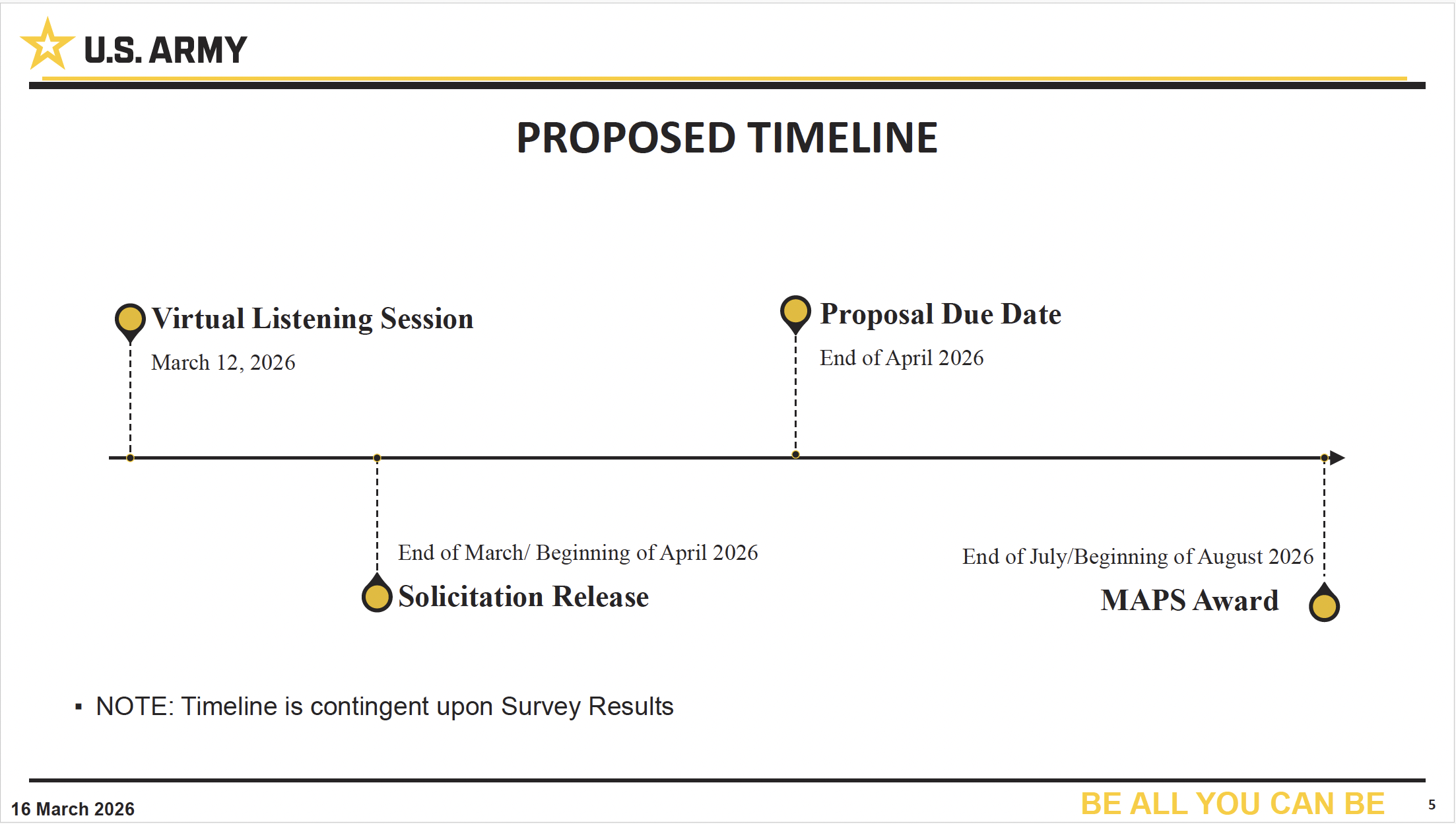
On March 10, 2026, the Army released update 7 to the MAPS program. This update featured the fifth draft of the RFP, announced a Virtual Listening Session on March 11, and initiated an industry survey to gather feedback on the draft RFP. The survey is open until 5 p.m. ET on March 17. Submit feedback here.
Army representatives presented key updates from the fifth draft RFP during the Virtual Listening Session, explaining major changes, their rationale, and the updated release schedule. Highlights are below; view the latest draft RFP here:
- Final RFP: The release is anticipated in late March/early April (depending on survey comments; survey is open through March 17)
- More Awardees:
- ELBs are companies that have graduated from the NAICS size standard within the last five years and have an average annual revenue from the last three years of less than $50M
- Thirty large business awards, 15 of which are “Emerging Large Businesses” (ELB)
- Twenty-five small businesses (SBs)
- Fifteen Commercial Service Vendors (CSV)
- Off-ramp Update: Awardees are no longer required to bid on at least 50 percent of the solicitations or risk being off-ramped
- IT Domain Changes: The latest draft removed the Intelligent Automation, Infrastructure, Services Platform, Infrastructure Cloud Services, and Telecommunications/Systems Ops and Maintenance areas from the IT Domain, as they are covered by other IDIQs
- Pricing: The only pricing required is a firm-fixed price (FFP) bid for up to two personnel to attend the virtual award session, and the bid must be between $50 and $100
- Qualifying Projects (QPs) Modified: What counts and is required as a QP was modified to the following updates:
- SBs can use subcontracts for their QPs
- Every QP must have a target goal or performance outcomes/end-product to be achieved
- Depending on which flavor of QP (performance outcome or end-product achieved) drives what type of proof must be submitted
- Passthrough rate points (for payment to subs) on the QPs is based on what you calculate out from the actual invoices; less than 30 percent is the best for points
- QPs must be signed by a government official stating that all submitted info is true/correct
This is the last draft the Army will release; however, they emphasized that interested bidders should take the survey to provide comments on the fifth version. While this will be the last draft before the final RFP is released, they will take any comments into account for changes to the final RFP.
UPDATE: On March 17, 2026, the Army released the Listening Session slides. Click here to find the deck.
We’ve been tracking how the U.S. Army Program Executive Office Enterprise Information Systems (PEO EIS) would proceed with updating its information technology acquisition program. This comes as both Information Technology Enterprise Solutions 3 (ITES-3S) and Responsive Strategic Sourcing for Services (RS3) -- ITES-3S and RS3 are set to expire simultaneously. We also tracked the ACG-APG's RS3 and Computer Hardware Enterprise Software Solutions (CHESS), now Product Lead (PL), updates when we attended AFCEA Fort Belvoir’s Industry Day in 2024. This consolidation of ITES-3S and RS3 has brought us to MAPS.
What is MAPS?
In August of 2025, the Army announced that MAPS, or Marketplace for the Acquisition of Professional Services, would be the consolidated solution. This solution is intended for U.S. Army knowledge-based professional support services for the Army enterprise infrastructure and infostructure.
This new opportunity will cover five domains: Engineering, Logistics, and Operational Services Domain (formerly Technical & Engineering Services); Management and Advisory Services; Research, Development, Test and Evaluation Services (RDT&E); Emerging IT Services; and Foundational IT Services.
Based on the Draft 006 information, the Army anticipates awarding 70 contracts per Domain. It plans to break those awards down into 30 Large Business awards (15 within Emerging Small Businesses), 25 Small Business awards, and 15 Commercial-Sector Vendor awards.
What’s a Commercial-Sector Vendor? This is one of the most exciting portions of MAPS, in my opinion, because we’ve spoken to many small business representatives who don’t have federal experience, but have lots of commercial experience. This Commercial-Sector Vendor is reserved for companies that have not yet done business with the federal government but are still registered in SAM.gov. We love to see it.
The pool of awardees will be based on scorecard point ranking – only the 70 highest-scoring proposals in each domain will receive an award, so every point matters.
Fast Facts
|
Contract Name |
Marketplace for the Acquisition of Professional Services (MAPS) (draft 6 listing) |
|
Description |
Provide Army customers and other agencies with knowledge-based support services and support the Army enterprise infrastructure and infostructure goals with information technology (IT) services worldwide. |
|
Primary NAICS Codes |
5 Domains: 541330, 541715, 561110, 541512, and 541519 |
|
RFP Release |
April 1, 2026 |
|
Submission Due Date |
May 1, 2026 |
|
Anticipated Award Date |
June 2026 |
|
Contract Ceiling |
$50 Billion |
|
Period of Performance |
2027–2037 – 10 years with a 5-year base, plus one, 5-year optional ordering period (based on the Nov. 5 draft Sections L & M) |
|
Types of Contracts |
Firm fixed price (FFP), Time & Materials (T&M), Cost Plus (CP) |
|
Customer Agencies |
U.S. Army, Program Executive Offices (PEO), Department of Defense (DoD), and other federal agencies |
|
Evaluation Method |
Strict Compliance (Gate 1) and Scorecard (Gate 2) |
|
On-ramp/Off-ramp |
Yes to both |
What’s Required for Submission
(based on March 2026 draft Sections L and M)
This is a strict compliance-based proposal with Gate Criteria, to be evaluated on a pass/fail basis. If your team does not clear the initial Gate Criteria, the rest of your proposal will not be evaluated. Once you’re clear of the Gate Criteria, the proposal is evaluated against a scorecard.
Based on the draft Sections L & M and Industry Day, you must submit all of the following items for your final :
- Volume I – Cover Letter (Attachment 001) (note that price is now included in the cover letter)
- Volume II – Screening Questions and Scorecard (Attachment 002)
- Volume III – Past Performance (Attachment 003)
- (Large Businesses only) Volume IV – Small Business Subcontracting
As it currently stands, you submit all of these with your proposal. We strongly encourage you to review the Gate Criteria and walk through questions before you prepare the rest of your volumes.
The Government will evaluate for award in four Phases. If your proposal does not clear a Phase, it will not be evaluated after that point.
- Phase 1: Initial Ranking based on Self-Score
- Phase 2: Verification Review and Downward Adjustments
- Phase 3: Preliminary Assessment
- Phase 4: Final Review and Award
Scorecard Evaluation
Section 1: Gate Criteria
The following Gate Criteria are the first step for evaluation for all businesses. If Offerors fail to meet these requirements, the rest of their submission will not be evaluated.
|
Large Business |
Emerging Large Business |
Small Business |
Commercial-Sector Vendors |
|
Active Secret Facility Clearance |
Active Secret Facility Clearance |
Active Secret Facility Clearance |
CMMC Final Level 2 (Self) Certification |
|
ISO 9001:2015 |
ISO 9001:2015 |
ISO 9001:2015 |
Commercial-Sector Vendor Confirmation |
|
CMMC Final Level 2 (self) or higher |
CMMC Final Level 2 (self) or higher |
CMMC Final Level 2 (self) or higher |
Registered in SAM.gov |
|
No more than 5% CPARS Marginal or below |
No more than 10% CPARS Marginal or below
|
No more than 5 CPARS elements rated Marginal or below |
|
|
Accounting System |
|
Small Business Certification |
|
|
Purchasing System |
|
|
|
Section 2: Scorecard Evaluation
If you meet the gate criteria, the next portion of your proposal is a scorecard-based evaluation that will review your specific systems, rate agreements, and certifications. If a company has an Active Top Secret Facility Clearance or ISO/IEC 27001:2022 Certification, there are additional points for each.
Within the Past Performance Section of the Scorecard, your company will earn points per QP in Recency, Relevancy, NAICS Alignment, Performance Quality, Dollar Value, Vacancy Rate, and Time to Fill Rate.
Recency requires a QP to have occurred within the last four years, but with at least a year of performance. If any of the QPs have a Period of Performance within the last two years, they will receive 1,000 additional recency points.
Relevance is the demonstrated technical capabilities for each domain proposed. Each Project will be evaluated against the domain’s technical capabilities and assigned a percentage score that translates into points based on how the provided QP aligns with the domain's technical capabilities.
NAICS Alignment earns an additional 1,000 points if the QP aligns with the proposed Domain NAICS.
Performance Quality is evaluated based on CPARS/PPQ elements with points for your overall rating. No points are awarded if any part of the evaluation is “Unsatisfactory.”
Dollar Value points may be earned if your average total contract value exceeds dollar value thresholds between $2.5M and $50M, depending on your business size.
Passthrough Rate points are received based on how much subcontractor labor dollars were spent in relation to the total labor dollars. More points are awarded for less subcontracted performance.
For Level of Effort QPs:
Vacancy Rate is evaluated within the last full year of performance based on the formula within the RFP. The Vacancy Rate determines additional points awarded.
Time to Fill Rate is evaluated with the formula within the RFP, calculated based on the average time to fill any job vacancy on the QP within the last full year of performance.
For Outcome-Based QPs:
Schedule points are achieved based on the percentage of AQL met.
Completeness points are awarded based on the number of documented efficiencies after AQL is met.
After the scorecard, the top 70 offerors in each domain will be evaluated by the Determination of Responsibility Assistant (DORA) bot to determine contractor responsibility.
Large Businesses will then have their Small Business Plan evaluated.
What is a Qualifying Project (QP)?
Reminder: This is based on the March 2026 draft Sections L and M. Always read the final RFP or latest Amendment for the final requirement.
Offerors may submit a maximum of three projects per proposed domain. Offerors must identify whether that project is an LOE or Outcome-Based QP. A QP must:
- Be a single contract (prime or commercial); a single Task Order (TO) under an IDIQ, BPA, or BOA; a TO under a Federal Supply Schedule; or an Other Transaction Authority (OTA) Agreement (note: it cannot be a subcontract)
- Have a $2.5M minimum total value,
- Have a minimum of one year of performance (for commercial-sector vendors, the QP shall be complete)
- Must have occurred within the last four years from the final date of solicitation,
- The QP’s assigned NAICS must be the same as one of the five overarching NAICS or one of the additional domain-specific NAICS.
What must bidders provide with each QP?
Bidders must provide the following information for each QP (again, no more than three QPs per domain are allowed, but you can use a QP for multiple domains) in addition to a certified copy of Attachment 003 for that project:
- Performance Work Statement (PWS) or Statement of Work (SOW)
- A copy of the Agreement if not a Federal Contract
- If no CPARs, PPQ Attachment 006
What are the Technical Capabilities for Relevance?
The table below includes the technical capabilities listed in the draft Sections L and M. Each QP will be evaluated against this list of capabilities for relevance.
|
Engineering, Logistics, and Operational Services Domain |
Management and Advisory Domain |
RDT&E Domain |
Emerging IT Domain |
Foundational IT Domain |
|
NAICS code: 541330 Or 541614 / 541712 |
NAICS: 541611 Or 611430 / 541712 |
NAICS code: 541715 Or 541614 / 541712 |
NAICS code: 541512 Or 541511 / 541712 / 518210 |
NAICS code: 541519 Or 541513 / 541712 / 611420 |
|
1. Engineering Services |
1. Acquisition and Strategic Planning |
1. Basic Research |
1. Big Data and Big Data Analytics Data Services |
1. Help Desk Support |
|
2. Logistics Services |
2. Financial Services |
2. Applied Research |
2. Quantum Computing |
2. Independent Verification and Validation (IV&V) |
|
3. Manufacturing Readiness |
3. Training Services |
3. Experimental / Developmental Research |
3. Business Process Reengineering (BPR)
|
3. IT Education and Training |
|
4. Medical Logistics |
4. Education Services |
4. Modeling and Simulation |
4. Network/Systems Operation and Maintenance Enterprise
|
4. IT Supply Chain Management |
|
5. Technology Insertion |
5. Program Management |
5. Prototyping and Fabrication Support |
5. Integration and Consolidation Information Technology Services
|
5. IT Management Services |
|
6. Integration |
6. Quality Assurance |
6. Exploratory Research |
6.Cybersecurity Services
|
6. IT Services |
|
7. Interoperability |
7. Risk Management |
|
|
|
Who Should Apply?
If your company meets the initial gate criteria, this may be a fantastic opportunity to expand into support for the U.S. Army and its subsidiary commands.
We say it every time and emphasize this point, especially with MAPS. Part of the reason for consolidating ITES-3S and RS3 is that the Army aims to ensure that Task Orders are awarded through a competitive process. The initial bid is only a small piece of the puzzle, as you will need to allocate additional resources, time, and effort toward the task orders once you’re awarded a contract. So, before you set out to tally your points in this strict compliance scorecard proposal, ask yourself:
- Can you manage the administrative demands with your current infrastructure?
The Government desires engaged contract holders. They've established several off-ramping thresholds to keep the contract filled with quality contractors.
- Contractor-induced Cost Overrun on awarded TOs
- Any Unsatisfactory CPARs on awarded TOs
- Average Vacancy Rate of 10% or more
- Average Time to Fill over 60 days or more
- Failure to receive the required CMMC assessment within the timeframes
The government intends to on-ramp in the future. So, continue to work on those requirements and explore the on-ramp when it comes up, if now is not the ideal time to pursue this opportunity.
Additionally, scorecards offer you an opportunity to scope your business development. With the scorecard in hand, you can evaluate bid options over the next year or so to pursue opportunities that can help you round out your submission for programs like MAPS. You can explore contracts that meet the QP requirements and build out your past performance experience. You may find OASIS+ is a great contract vehicle to help you build out those Task Orders, and with OASIS+ Phase II open continuously, now is the time to begin evaluating your own experience to see if you are a good fit. We can help with that!
Next Steps
Review the scorecard and answer all the questions. If you can meet the draft Gate Criteria, or need help determining your eligibility, contact Trident. Make sure you subscribe and follow to stay in the loop with industry updates, changes to the solicitation, and Trident support packages for this exciting opportunity. Subscribing to MAPS via SAM.gov can also ensure you receive the most up-to-date information. You’ll also need access to the Submission Portal. SAM.gov has instructions on how to access that portal.
We’ve been active in the industry this year, and all of the conversations have held a central theme: the Government wants you to participate. Respond to industry feedback requests, ask questions, and stay engaged to help shape acquisitions. If you’re ready to pursue MAPS, don’t hesitate to reach out to Trident today.
Written by Kiley Stewart
Kiley is a capture and proposal manager at Trident. She brings her proposal management, technical editor, competitor analysis, and resume development skills to clients. She is also the voice of the Trident Short podcasts and one of the team members you’ll talk to when you reach out. A U.S. Navy veteran and military spouse based on the East Coast, she supports clients around the world as part of our globally dispersed team.