GSA OASIS+ Phase II: Everything You Need to Know
Oct 04, 2026
Updated Oct. 5 2026
We’re happy to introduce our second GSA OASIS+ Phase II blog, designed to help those companies responding to Amendment 0008 and beyond. If you’ve visited this link before, you may notice some information has been updated or moved around. Don’t worry – you’re still in the right place for all things OASIS+! We’ll be keeping this blog up to date with the latest guidance, tips, and strategies to help you win a seat on this critical contract vehicle.
Table of Contents
- NEW: GSA Announces More Awardees (July-September 2026)
- GSA Announced More Awardees; Releases Updated QA
- GSA Announces First Round of Phase II Awardees
- GSA Releases 120+ Q&As
- GSA Releases First Round of Q&A
- GSA Releases Phase II and Continuous On-Ramping with Amendment 0008
- Who can bid on OASIS+ Phase II?
- What’s the biggest difference between Phase I and Phase II?
- What else do I need to know about OASIS+ Amendment 0008?
- How to Get Ready
NEW UPDATES
NEW: GSA Announces More Awardees (July-September 2026)
July through September brought more awardees to the OASIS+ Phase II onramp. GSA posted additional awardees to the website, bringing it to a total of 166 awardees on OASIS+ Phase II (55 domain modifications and 9 MPJVs. By socioeconomic breakdown, the latest count is:
- Small Business: 51
- July 22: 7
- July 29: 8
- Aug. 5: 9
- Aug. 12: 2
- Aug. 19: 1
- Aug. 26: 6
- Sept. 2: 3
- Sept. 11: 1
- Sept. 16: 3
- Sept. 23: 6
- Sept. 30: 5
- 8(a): 10
- July 29: 2
- Sept. 2: 7
- Sept. 16: 1
- HUBZone: 1
- July 22: 1
- SDVOSB: 18
- July 22: 4
- July 29: 4
- Aug. 5: 3
- Aug. 12: 1
- Aug. 26: 5
- Sept. 2: 1
- Sept. 9: 1
- Sept. 11: 1
- Sept. 16: 1
- Sept. 30: 2
- WOSB: 15
- July 22: 3
- July 29: 1
- Aug. 5: 2
- Aug. 19: 2
- Aug. 26: 1
- Sept. 2: 2
- Sept. 16: 2
- Sept. 23: 2
- Sept. 30: 1
- Unrestricted: 25
- July 22: 5
- Aug. 5: 7
- Sept. 2: 3
- Sept. 9: 1
- Sept. 16: 2
- Sept. 23: 4
- Sept. 30: 3
Total Phase II Awardees (as of Sept. 30, 2026)
We used Copilot to review the latest award announcement for a full breakdown of domain awards by socioeconomic categories:
| Domain | Total Small Business | 8(a) | HUBZone | SDVOSB | WOSB | Unrestricted |
|---|---|---|---|---|---|---|
| Technical & Engineering (T&E) | 23 | 4 | 0 | 13 | 8 | 13 |
| Research & Development (R&D) | 7 | 0 | 0 | 3 | 5 | 4 |
| Management & Advisory (M&A) | 25 | 8 | 2 | 16 | 10 | 11 |
| Environmental | 10 | 0 | 0 | 0 | 0 | 1 |
| Intelligence Services | 8 | 0 | 0 | 2 | 3 | 4 |
| Facilities Services | 2 | 1 | 0 | 2 | 1 | 3 |
| Logistics | 7 | 1 | 0 | 3 | 3 | 4 |
| Financial Services* | 7 | 0 | 0 | 1 | 0 | 4 |
| Business Administration* | 11 | 3 | 0 | 4 | 2 | 6 |
| Human Capital* | 13 | 1 | 0 | 4 | 4 | 4 |
| Marketing & PR* | 9 | 3 | 1 | 0 | 5 | 1 |
| Social Services* | 1 | 0 | 0 | 0 | 1 | 0 |
| Enterprise Solutions | 0 | 0 | 0 | 0 | 0 | 1 |
Counting notes
- Each awardee is counted once per domain within each tab, regardless of how many CLINs the awardee received in that domain.
-
An awardee may be counted in multiple domains.
-
A company appearing on multiple socioeconomic tabs is counted separately in each corresponding column.
Previous Updates
NEW: GSA Announces More Awardees; Releases Updated Q&A
Throughout June, GSA posted additional awardees to the website, bringing it to a total of 46 awardees on OASIS+ Phase II. Of these 46, three are domain modifications (1 in unrestricted, 2 in total small business). By socioeconomic breakdown, the latest count is:
- Small Business: 22 (May 12: 5; June 9: 7; June 17: 2; June 24: 8)
- 8(a): 1 (Added June 24)
- HUBZone: 1 (Added June 9)
- SDVOSB: 12 (May 18: 2; June 9: 5; June 24: 5)
- WOSB: 7 (May 12: 1; June 9: 6)
- Unrestricted: 3 (Added June 24)
They also released 76 more Q&A in June. There are now 252 Q&As on the continuously open solicitation page.
NEW: GSA Announces First Round of Phase II Awardees
On May 12, 2026, GSA announced the first round of Phase II awardees. Eight companies received the first round of selection. By socioeconomic breakdown, they are
- Small Business: 5
- 8(a): 0
- HUBZone: 0
- SDVOSB: 2
- WOSB: 1
- Unrestricted: 0
They posted the below notice on SAM.gov for each opportunity:
May 12, 2026 The U.S. General Services Administration’s Office of Acquisition Solutions Development (ASD) is pleased to announce the first Phase II apparent awardee notifications for OASIS+ Total Small Business Set-Aside. A consolidated list of Phase II apparent awardees for all OASIS+ contract families may be accessed on the Solicitations (continuously open) page (see “Links” section within this SAM.gov posting). This list will be updated with additional apparent awardees as award announcements continue to be made.
Award notifications have been sent via email to offerors who have been determined successful in one or more proposed domains. Apparent awardees are reminded to ensure that their SAM.gov entity information is active, accurate, and complete at all times. The program plans to issue formal awards and notices to proceed (NTPs) to qualified contractors on or about May 22, 2026 after final legal reviews occur. The newly awarded contracts will be available for ordering in GSA eBuy one business day following the issuance of formal awards and NTPs and upon contractor registration within the Vendor Support Center (VSC), whichever is later. Contract awardees must register their contracts in VSC before they will be visible in eBuy and available for procurement.
Please note that GSA continues to release answers to RFP questions deemed broadly beneficial and relevant on a regular basis on the program website Solicitations (continuously open) page. Questions related to the award announcements should be submitted via email to the OASIS+ Contracting Officers at [email protected].
Please continue to monitor this OASIS+ Interact Community forum where you can join and subscribe to get notifications about announcements and program updates. For more information about the OASIS+ Program, visit: The OASIS+ website. Also, follow our social media channels X and LinkedIn.
GSA Releases 120+ Q&As
On April 15, 2026, GSA released more than 120 questions and answers regarding Phase II. GSA also included:
This document contains questions received under the open continuous solicitation. This is a living document—we continue to review the questions, and add new Q&As on a rolling basis. Check back regularly for updates.
GSA Releases First Round of Q&A
On March 17, 2026, GSA released the first round of Q&A. GSA also included:
This is a living document—we continue to review the questions, and add new Q&As on a rolling basis. Check back regularly for updates.
NEW: GSA Releases Phase II and Continuous On-Ramping with Amendment 0008
On Jan. 13, 2026, GSA released the final RFP amendments for Phase II! This final RFP introduces five new domains, bringing the total to 13.
OASIS+ Phase II RFPs
The six final solicitations include the following set-asides and unrestricted contracts:
- Total Small Business (SB)
- SBA-Certified 8(a) SB (8[a])
- SBA-Certified HUBZone (HZ)
- SBA-Certified Service-Disabled Veteran-Owned SB (SDVOSB)
- SBA-Certified Women-Owned SB (WOSB)
- Unrestricted (UR)
Who can bid on OASIS+ Phase II?
You are in the right place if one of the following situations describes you:
- “New” Offerors: This describes you if you do notcurrently have an active OASIS+ contract and are looking to get one (in any domain). This group may include companies that submitted unsuccessful bids in the first round of proposal submissions.
- Current OASIS+ Contract Holders looking for more IDIQs, aka “Lateral Springboards”: This describes you if you were awarded an OASIS+ contract under one socio-economic IDIQ and now qualifyfor another socio-economic category. (There are six separate IDIQs under the OASIS+ program: Unrestricted, Small Business, HUBZone, Service-Disabled Veteran-Owned, 8(a), and Woman-Owned).
- Current Contract Holders looking for more Domains, aka “Domain Enhancement”: This describes you if you have an activeOASIS+ contract in any IDIQ and Domain(s) and you are looking to add Domains/CLINs to your IDIQ(s). Remember, under the OASIS+ program, Domains are like functional areas of expertise. Domain Enhancement applies whether you’re looking to add Phase I or Phase II Domains (more on that below), as long as you have an existing OASIS+ contract.
We drew this out graphically, as we know it’s sometimes easier to see.
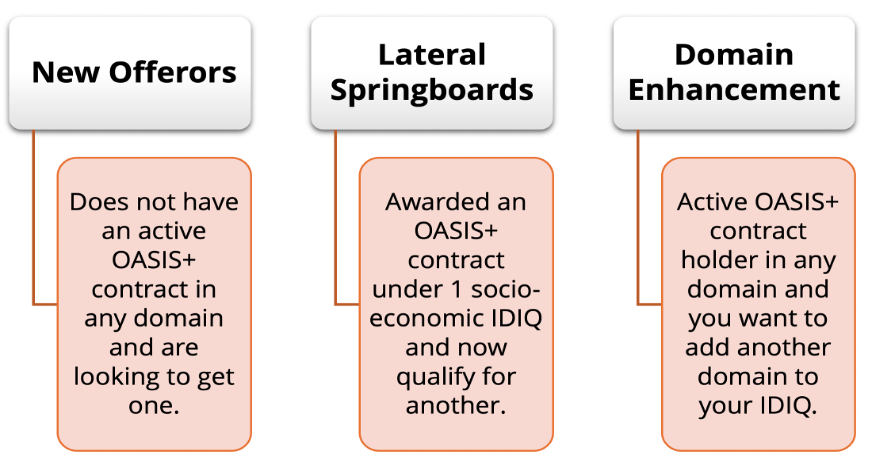
Please note, companies cannot hold more than one master contract within any IDIQ.
What’s the biggest difference in Phase I and Phase II?
The biggest change between Phase I and Phase II is that the solicitation is now operating much like a GSA Multiple Award Schedule where it is continuously open for proposals and there will be “rolling” contract awards. While there is currently no closing date for the solicitation (and thus no “due date” for proposals), it is important to note that this does not mean GSA will not amend, modify, or close the any domain or solicitation vehicle. Should this be a necessary action in the future, GSA has said that “the agency will provide public notification with sufficient advance notice.”
With no due date, you may be wondering about how long it will take GSA to make awards. What they shared with the Amendment 0008 release is that “there is no fixed timeline for award; timelines will vary based on the volume of proposals received. Proposals will generally be evaluated in the order they are received, subject to resource availability.”
What else do I need to know about OASIS+ Amendment 0008?
Beyond the shift to a continuously open solicitation, there were a few other notable updates. We’ll cover the highlights first, then dive into the five new domains.
- All offerors must acknowledge Amendment 0008 in their
- If you submitted a bid for Phase I and were unsuccessful, you will need to include a response to the debriefing letter addressing each finding in your new offer. Check out RFP Section L.5.9 Rejection of Previous Offer for more information.
- GSA issued Attachment J.P-14 Lateral Springboard Summary Sheet for existing Phase I contract holders who are requesting to be awarded IDIQs in a set-aside that they now qualify for.
- Qualifying Projects used in Phase I may be reused in Phase II – with some caveats. Projects and documentation used to qualify for Phase I may be leveraged to support Phase II if the projects meet the qualifying criteria of Phase II domains. Phase II bidders will still need to substantiate their self-scores, so providing documentation is key to supporting claims made about experience and capabilities. Supporting projects (and documentation) should be directly relevant to the specific domain(s) you’re targeting in Phase II. Note that a project is still prohibited from being used in two proposals for the same Domain and IDIQ.
- Eligibility for Phase II is not tied to participation in Phase I. You are not required to have won a Phase I IDIQ to participate in Phase II. All interested offerors who meet eligibility requirements are qualified to submit a proposal (Note: If you did win an IDIQ in Phase I, you will be permitted to re-use certain proposal artifacts if you are adding domains to that contract under the Lateral Springboard option.).
- And, of course, there are Five *NEW* Domains. This brings the total number of OASIS+ domains to 13. These domains are:
- Technical & Engineering (T&E)
- Research & Development (R&D)
- Management & Advisory (M&A)
- Environmental
- Intelligence Services
- Facilities Services
- Logistics
- Financial Services*
- Business Administration*
- Human Capital*
- Marketing & PR*
- Social Services*
- Enterprise Solutions (Note: this domain is in the Unrestricted IDIQ only).
It’s also important to note what did NOT change with Amendment 0008 – namely that OASIS+ will remain a professional services vehicle. GSA did not add software-related NAICS codes to any existing or new domains, reinforcing that OASIS+ will remain a vehicle primarily for professional services, not for Information Technology services/products/support. Additionally, RFP Section C.5, Services Not in Scope, provides more information on which services will NOT be permitted under OASIS+.
Here’s an overview of the contract to date:
|
Contract Ceiling |
None! |
|
Period of Performance |
10-year continuous IDIQ |
|
Customer Agencies |
Government Wide Acquisition Contract (GWAC) designed for Federal agencies |
|
Competition Type |
6 Separate IDIQ Vehicles: Unrestricted, Small Business, Woman-Owned Small Business, HUBZone, Service-Disabled Veteran-Owned Small Business, and 8(a) |
|
Evaluation Method |
Scorecard with credits from a combination of project experience and corporate certifications. Minimum Qualifying Thresholds: |
|
# of Awards to Date |
No maximums! As of Oct. 6, 2025, the number of awardees in each IDIQ is as follows: |
|
Allowable Task Order (TO) Award Types |
All contract pricing types are authorized but cost reimbursable and Time and Materials TOs require approved cost accounting systems. |
|
Pricing Requirements |
Evaluated at the TO level only. Each offeror must submit fair and reasonable rates for designated LCATs. |
|
Minimum Contract Obligation |
Must achieve $250k minimum in the first 5 years |
|
Teaming |
JVs and CTAs are permitted. For the SB IDIQs, all teammates must represent in the same size standard for the Prime’s Domain(s). |
Number of Phase I Awards by Domain (as of Oct. 6, 2025)
|
Domain |
||||||
|
Management & Advisory Services |
433 |
993 |
346 |
320 |
317 |
113 |
|
Technical & Engineering Services |
429 |
956 |
285 |
283 |
288 |
91 |
|
Intelligence Services |
154 |
265 |
58 |
56 |
116 |
17 |
|
Research & Development Services |
158 |
242 |
42 |
53 |
51 |
8 |
|
Logistics Services |
107 |
181 |
41 |
46 |
68 |
10 |
|
Facilities Services |
76 |
168 |
60 |
42 |
53 |
14 |
|
Environmental Services |
53 |
100 |
38 |
27 |
11 |
8 |
|
Enterprise Solutions Services |
29 |
N/A |
N/A |
N/A |
N/A |
N/A |
If you’re new to this bid, it’s vital to understand that OASIS+ is a scorecard evaluation, and there is a specific scorecard for EACH Domain. Said another way, you may not receive the same score in the Technical & Engineering Domain that you do in Research & Development because the qualifying criteria vary between the two Domains.
How to Get Ready: Tips to Help you Bid
If you followed any of our other MA-IDIQ or GWAC campaigns, the first thing we ALWAYS recommend is that you ask yourself, “Is OASIS+ the right prime contract for me?” In other words, is it a contract you can realistically manage and that your government clients can/will use? As with all IDIQs, the initial bid is the easy part. Winning work on task orders will require additional time, resources, and effort. We’d encourage a quick “time out” before you start tallying any points to ask yourself a few key qualifying questions:
- Do you have current Federal customers who are using or are likely to use OASIS+ for future acquisitions? (If you don’t know the answer to this question, contact us - our Business Analysts can help!)
- Can you manage the administrative demands of a GSA contract within your current contract support infrastructure?
- Are you willing and able to meet the marketing, minimum contracting thresholds, and participation requirements that come with a win?
Answering “No” to the questions above shouldn’t lead to an automatic “no bid.” However, it should give you pause and help you calibrate your definition of what success looks like on OASIS+. Your goal should be to stay on the contract for the long term and make it work for you, not just secure an initial award. Think through how you will manage work once you’re on the contract, and then let that plan inform your strategic bid, hiring, teaming, or business development decisions.
Another important note regarding contract management. GSA has said that they reserve “the unilateral right to off-ramp non-performing contractors” (source). There are five conditions currently spelled out on their website here. Ensure you can not only bid on the IDIQ but also meet the requirements to remain on it.
Once you are confident that OASIS+ is a vehicle you can use and manage successfully, we recommend the following steps:
#1: Build a Qualifying Project Tracker. This doesn’t need to be complex, but think of it as a master index for any project you’re considering for OASIS+. You can download our free template here. The point of the tracker is to have a quick-look reference for your projects so that you can tell right away which projects are even considered eligible based on contract/project type, recency, and average annual value.
A tool like this can also help inform your teaming conversations. During Phase I, offerors could use qualifying relevant experience from teammates. If you get “invited” to form a team, this tracker can help you understand where you already have project coverage and where you might need it. That means you can have a very clear, data-driven conversation about what type of qualifying experience will actually enhance your score.
#2: Check on those SAM.Gov registrations and company certifications. Is anything coming due for renewal or at risk of expiring in the next six months? If you are a repeat OASIS+ bidder, has anything changed since you submitted for Phase I (e.g., now you have facility clearance or CMMC Level 2 certification)? Symphony pulls your company data from SAM.Gov, so make sure you take a look at your registrations and representations early.
#3: Register for Symphony. While we don’t encourage new bidders to start uploading files immediately, it is important to get access to the submission portal early. You’ll want access so that you can see how your company information will be organized, how your project data will be cataloged, and how building a proposal within your designated IQIQ(s) and domain(s) will actually work. Plus, you’ll need access to Symphony if you want to ask any questions! You can register using this link: Symphony Procurement Suite. Note: You can use your email address only once, and you’ll need your company’s UEI and CAGE code if you are a new user.
#4: Calculate your self-score (and if applicable, understand what went wrong). The great thing about a scorecard bid like this is that if you do your homework, you’ll know your chances of success before you even hit “Submit” on your proposal. Take some time upfront to do a self-score, and if you need help determining whether you are eligible, contact us! Whether you’re brand new to OASIS+ or are just looking to round out your contract by adding domains, we can help by reviewing your projects through the lens of a GSA evaluator. Also, if you were not successful in your initial Phase I bid, it is CRITICAL that you understand why you did not receive an award before you submit for Phase II. If you need help understanding your notice or reviewing your proposal, contact us! Want a second set of eyes? We can help!
#5: Bookmark this page! We’ll keep this blog updated as guidance becomes available. Subscribe to our monthly newsletter -- Click the “subscribe” button on our blog page to be notified about new blog releases. And follow us on LinkedIn, X (formerly Twitter), and YouTube for all the latest updates. We’re also starting an exciting new “Ask Me Anything” series just for OASIS+! Join us on the second Wednesday of each month, where you can ask our experts questions during a live office hours. Our upcoming AMA sessions are linked below:
- February AMA Sign Up
- March AMA Sign Up (Coming Soon)
- April AMA Sign Up (Coming Soon)
- May AMA Sign Up (Coming Soon)
We have several blogs that touch on a similar topic. Check out these blogs below:
- Knowing When to Bid on Self-Scoring Proposals
- Navigating Joint Ventures in Government Contracting
- Top 5 Tips to Leverage a New IDIQ Contract
- Virtual Dispersed Teams add Value and Time to Your Proposal Management
Written by Rebecca Wayland
Rebecca is our Chief of Staff. As a Grey Team member, she offers comprehensive proposal management, capture support, market research, and training. She is also our GWAC and MA-IDIQ lead, so if you’re exploring OASIS+ (Phase II or the on-ramp), MAPS, or SHIELD, she is definitely your SME. As a U.S. Navy veteran and military spouse based in Hawai’i, she supports clients around the world as part of our globally dispersed team.