From Concept to Combat Power: What the CNO's Sea-Air-Space Message Means for GovCon
May 15, 2026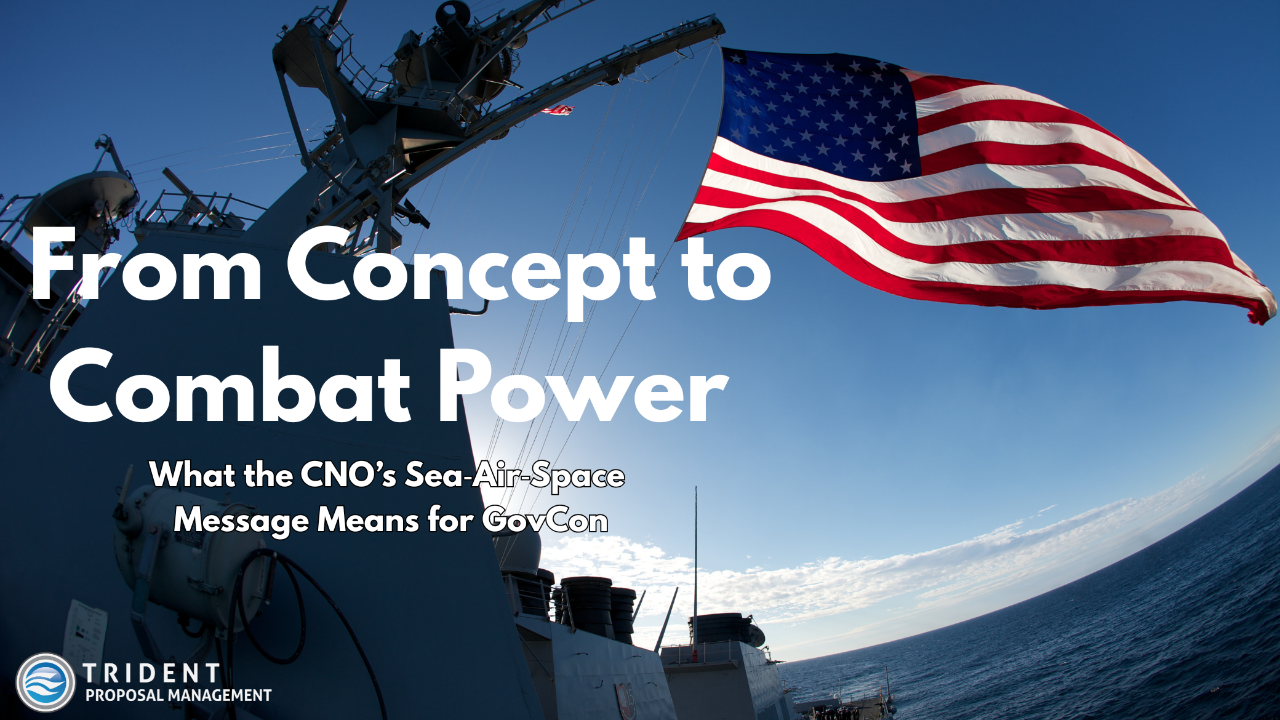
Reading time: 5-1/2 minutes
At Sea‑Air‑Space 2026, Chief of Naval Operations Adm. Daryl Caudle delivered a message that was both unambiguous and urgent: the Navy has moved past debating what needs to change and is now focused on how fast it can deliver. His remarks were not theoretical. They were operational, practical, and aimed squarely at the government contracting industry.
“We have moved past the point of the intellectual argument,” Caudle said. “We are now in a phase of ruthless execution and uncompromising accountability because in today’s environment, speed of decision and execution [is] not a luxury. They are warfighting requirements.”
That frame set the tone for the entire lunch discussion—from the Golden Fleet Initiative to the Fleet Introduction Operating System (FIOs), to what Caudle expects next from government contractors.
The Golden Fleet: Moving Beyond Platform-Centric Thinking
At the core of Caudle’s message was the Golden Fleet Initiative. He was explicit that this is not about ships, programs, or individual systems.
“The Golden Fleet Initiative is not a collection of platforms,” he said. “It’s a warfighting system.”
Rather than optimizing individual platforms, the Golden Fleet is designed to optimize naval combat power across the force as an integrated system. This involves integrating crewed and uncrewed platforms, payloads, artificial intelligence, modular systems, and containerized capabilities into mission-focused packages to address a specific problem. The goal is adaptability at scale, which means the Navy can tailor forces to the operational mission rather than to fit the generic model.
“Combat power is now defined by how fast we can integrate, adapt, and deliver effects.” That definition marks a clear break from past approaches. Success is no longer measured by exquisite high-end platforms alone—like aircraft carriers or stealth warships—but by how effectively those systems are integrated with scalable, adaptable capabilities across the force. What matters now is the speed at which capabilities can be assembled, certified, deployed, and reconfigured as the fight evolves.
Caudle reinforced this point with a real-world operational example: a submarine that was rapidly retrained, redirected, and integrated into a new theater to deliver immediate effects. In other words, the Navy’s edge comes through speed and adaptability. As he put it, “Within days, not months, she [the submarine] was in the fight, integrated, ready, lethal the fight, sinking an Iranian warship, and executing precision strike missions that only the Navy could provide within this time frame.” He emphasized that this was not improvisation, but deliberate design.
“That’s differentiated value. That was a glimpse of the future force—speed that's reached, that's infallible. And we did it not to succeed in that moment because we had more platforms, but because we adapted faster than the problem.”
FIOs: Ending the Fleet as the Integration Lab
If the Golden Fleet defines the operational vision, FIOs define the delivery mechanism. Caudle was blunt about what has historically slowed the Navy down. It's not technology, but integration Too often, capabilities arrive incomplete, unintegrated, or not ready to fight as part of a larger system, he said. FIOs is designed to change that.
Under the FIOs, new capabilities and upgrades should arrive the way modern software does, seamlessly, consistently, and ready for operational use.
That means:
- Common interface standards
- Open architecture and modularity
- Virtualization and digital twins
- Training content built in from day one
- Lifecycle integration planned before delivery
“This is how we end the era where the fleet is the integration lab,” he said plainly. FIOs also underpins the Navy’s push to embed more capabilities in containers (aka containerized). This enables payloads to move quickly across platforms and missions. Caudle’s statement was simple: if a capability fits in a container, it should be able to move, scale, and fight anywhere in the fleet—at speed and at scale.
The Industry Moment: From Concepts to Combat-Ready Systems
Perhaps the most direct part of Caudle’s message was aimed at the GovCon industry. He was clear that contractors are no longer just suppliers. Instead, they are force multipliers. But that role comes with new expectations.
“Stop bringing me concepts that only work in isolation,” he said. What the Navy needs now are capabilities that arrive ready to fight—integrated, modular, scalable, interoperable, and sustainable across the full lifecycle, Caudle said. Systems must be designed with employment in mind, not just performance on paper.
“If your system cannot plug into a tailored force package,” he warned, “then it is not relevant to the fight we are preparing for.”
Integration speed is now decisive. He emphasized that advantage no longer goes to the side with the most platform, but to the side that adapts fastest—speed of sensing, speed of decision, and speed of adaptation. “If we are slow to adapt,” he said, “we will be outpaced before we are outgunned.”
What This Means for Proposals and Capture Strategy
For defense contractors, Caudle’s message translates into a very practical proposal and capture reality. The Navy is no longer evaluating capabilities in isolation—it is evaluating how quickly and effectively those capabilities contribute to combat power as part of a larger system.
Winning solutions will clearly demonstrate:
- How the capability integrates into a tailored force package
- How it scales across platforms, payloads, and mission sets
- How it can be updated, upgraded, and sustained with minimal disruption
- How it supports faster deployment
- How it reduces integration burden on the fleet rather than shifting that risk to the Sailor
This is a fundamental shift. Proposals that focus solely on individual system performance, without addressing integration, adaptability, and lifecycle readiness, risk missing the Navy’s stated direction—no matter how technically impressive the solution may be.
As Caudle emphasized, advantage now goes to the side that adapts fastest. If a capability cannot integrate, scale, and evolve at operational speed, it is not aligned with where the Navy is headed.
A Clear Call to Action
The takeaway from Admiral Caudle’s remarks is unmistakable. The Navy has issued its demand signal, and industry’s response will determine whether capability can be delivered at the speed of relevance.
✓ Build systems that integrate.
✓ Build systems that scale.
✓ Build systems that sustain in contact.
✓ Build systems that can be delivered early and iterated continuously.
✓ And above all, build for the Sailor.
“Every system we build, every capability we field, ultimately lands in the hands of our sailors," Caudle reminded the audience. “If it’s not ready for them, it’s not ready. Period.”
That standard does not conflict with the Department of War’s acquisition reforms—it defines them. The Acquisition Transformation Strategy makes this explicit, directing programs to “prioritize the purchase of equipment and weapons that meet our needs faster, even when they do not meet every requirement" (page 9). That doesn’t mean half‑ready systems. It means being flexible on requirements so we can field earlier, while still delivering something Sailors can actually use. Iteration comes after delivery—not at the Sailor’s expense.
The Golden Fleet is a big pivot for the Navy, enabled by FIOs and executed through tailored forces. For government contractors, it’s an opportunity to turn innovation into an operational advantage rather than just promising concepts. If your team is chasing quick-turn RFPs or trying to translate “innovation” into a clear, compliant, and compelling response, Trident can help. Our team can supplement yours during surge periods, enabling you to move faster with an innovative, high-quality solution.
Read more about the Golden Fleet Initiative in the CNO’s C-Note #7: Golden Fleet Initiative and Our Future Fleet Design (NAVADMIN 100/26) and FIOs in C-Note #8: Continuous Improvement as Warfighting Advantage (NAVADMIN 107/26).
Written by Karen Haddock and AI*
Karen is a proposal manager at Trident Proposal Management and a former U.S. Army Officer with extensive experience in project management, logistics, and education. Based on the East Coast, she supports clients worldwide as part of our globally dispersed team.
*This blog was primarily generated by AI, with Karen Haddock contributing original content and oversight. Every AI-assisted piece is reviewed, corrected, and validated by a Trident employee to ensure quality and authenticity. We value the human factor while leveraging AI's efficiency.